
Procedure
Coronary and peripheral intervention
Imaging the arteries to find out where they are narrowed, and opening them where the narrowing is what is causing the symptoms. Planned, scheduled work in selected patients.
This is planned treatment, not emergency treatment
Everything on this page is elective work in stable, carefully selected patients — a scheduled visit for a narrowing that has been investigated and discussed. A heart attack is a different situation entirely and needs a hospital with an emergency catheterisation service, not an ambulatory surgery center. If you have chest pain that is severe, new, at rest, or lasting more than a few minutes, call 911. Do not call the center, and do not drive yourself anywhere.
The Procedures
Three procedures, one sequence
Find the disease, decide whether it needs treating, treat it where it does. Often all three happen in a single visit.
Coronary angiogram — finding out
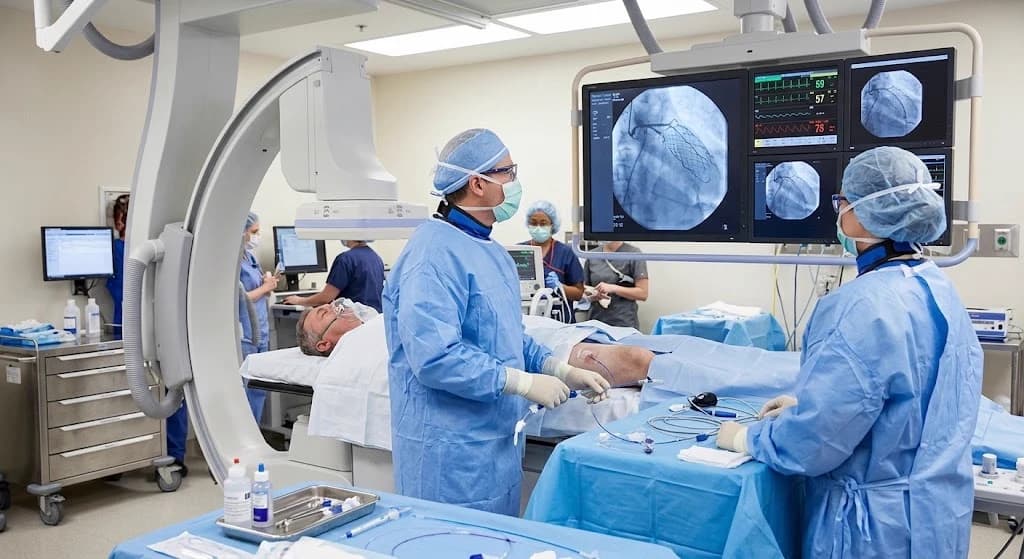
A catheter is passed to the mouth of the coronary arteries, usually through the wrist, and contrast is injected while X-ray images run. What comes back is a map of the arteries: which are narrowed, by how much, and exactly where. Nothing is treated during a diagnostic angiogram — it is the study that decides whether treatment is needed at all, and if so whether that means medication, a stent, or surgery.
Coronary intervention — opening it
Where a narrowing is significant and is causing symptoms, a fine wire is passed across it, a balloon is inflated to widen the artery, and a stent is left behind to hold it open. In many cases this follows the angiogram in the same visit, so one procedure answers the question and treats it. Medicare added coronary angioplasty and stenting to the procedures covered in ambulatory surgery centers with effect from January 2020.
Peripheral intervention — the same problem elsewhere
Arteries narrow outside the heart too, most commonly in the legs. The tools are the same — wires, balloons, stents — and so is the sequence: image first, treat where the disease and the symptoms justify it. The typical symptom is cramping pain in the calf or thigh that comes on while walking and eases within a few minutes of stopping.
Indications
What brings patients here
Symptoms with a pattern. Arterial disease tends to declare itself predictably, which is what makes it recognisable.
- Chest pain or breathlessness on exertion
- Symptoms that appear predictably with effort and settle with rest are the classic pattern of a coronary narrowing limiting blood flow when the heart is asked to do more.
- An abnormal stress test
- A stress test suggests that part of the heart muscle is not getting enough blood, but it cannot say which artery or how tight. An angiogram answers both.
- Leg pain that limits walking
- Cramping in the calf or thigh brought on by a predictable walking distance and relieved by rest points to peripheral arterial disease, and imaging defines whether it can be treated by catheter.
- A non-healing wound on the foot or leg
- Wounds need blood supply to close. Where poor arterial flow is the reason a wound is not healing, restoring that flow changes the outlook considerably.
The Visit
What the day looks like
Most of this is done through the wrist rather than the groin, which is why you can sit up sooner and go home the same day.
- 1
Before you come in
You will be told when to stop eating and drinking, and which medications to take that morning — blood thinners and diabetes medication in particular need specific instructions. Kidney function is checked beforehand, because the contrast used is cleared by the kidneys. Arrange for someone to drive you home.
- 2
Access, usually at the wrist
Most procedures are done through the radial artery at the wrist rather than the groin, which lets you sit up sooner afterwards and has a lower rate of bleeding complications. The site is numbed with local anaesthetic; you are sedated but not asleep.
- 3
The angiogram
Catheters are advanced to the coronary arteries and contrast is injected while images are recorded. You may be asked to hold your breath briefly. Some people feel a warm flush as the contrast goes in, which passes in seconds.
- 4
The decision
Your physician reviews the images while you are on the table. If nothing needs treating, the procedure ends there. If a narrowing should be stented, that is discussed with you — this is why sedation here is light enough for you to take part in the conversation, and why the possibility is consented in advance.
- 5
Stenting, where it is indicated
A wire is passed across the narrowing, a balloon widens it, and a stent is placed. Pressure or imaging measurements inside the artery are sometimes used first to confirm the narrowing is actually limiting flow rather than simply looking tight.
- 6
Recovery and going home
A band is applied to the wrist and gradually released as the artery seals. You are monitored for a defined period, and most patients go home the same day. If a stent was placed you will leave on antiplatelet medication, and taking it exactly as prescribed matters — stopping early risks the stent clotting.
Risks
What can go wrong, and how likely it is
Serious complications are uncommon in selected patients. These are the ones worth understanding before you consent.
Bleeding or damage at the access site
Bruising is common. Less often the artery is damaged or a collection of blood forms, and the radial approach used here has a lower rate of serious access-site bleeding than the groin.
Contrast and the kidneys
The X-ray contrast is cleared by the kidneys and can worsen function in people whose kidneys are already impaired. Function is checked beforehand, hydration is managed, and the volume of contrast is kept as low as the procedure allows.
Heart attack, stroke, or arrhythmia during the procedure
Uncommon, and the reason these procedures are done in a monitored room with resuscitation equipment, defined protocols, and a transfer agreement with a hospital for the case that needs one.
Stent thrombosis
A stent can clot, most dangerously in the first months while it is still being covered by the vessel lining. This is what the antiplatelet medication prevents, and it is why the prescription is not optional or negotiable.
Restenosis
A treated artery can narrow again over time. Modern drug-eluting stents have made this much less common than it once was, but it remains a reason symptoms can return and need reassessing.
Radiation and contrast allergy
X-ray exposure is kept to the minimum the procedure requires. Tell the team in advance about any previous reaction to contrast or to shellfish or iodine, so premedication can be arranged.
Sources
Questions about your procedure?
Our team will confirm your date, walk you through preparation, and answer questions about insurance, sedation, and recovery.