
After your procedure
Your access site
Your catheters went in through an artery or a vein, and that opening has to be closed. There are three ways we do it, and which one you had is decided during your procedure.
If you went home with a device still on
Leave it on for at least 6 hours. The morning after your procedure is also fine.
That is the V-Close, an external compression device. Everything you need is in the removal instructions below. If anything is unclear, call us on (602) 456-2342, ext. 3000 before you start — not after.
The three ways we close the site
Your physician chooses during the procedure, from what they find — the artery, the access, and how you are doing. You will be told which one you had before you go home, and it will be written on your discharge instructions.
Two of the three need nothing from you at all. The third does.
A stitch, placed from the inside
Perclose
A suture is delivered through the same sheath the catheters went through, and tied to close the artery from within. The knot stays; there is nothing on the surface holding it.
Nothing for you to do. Nothing to remove and nothing to do. You will have a small entry point that is closed under the skin. Follow the usual advice about keeping it clean and dry and not lifting anything heavy.
A plug that dissolves
Mynx · Vascade · Angio-Seal
A small collagen or sealant plug is deposited against the outside of the artery, where it swells and seals the opening. Your body absorbs it over the following weeks — usually 30 to 90 days.
Nothing for you to do. Nothing to remove and nothing to do. The plug is inside and dissolves on its own. Tell any clinician who needs the same artery in the next few months that you have had one, since it changes how they approach the site.
An external compression device
DRS Vascular V-Close
Rather than sealing the artery from the inside, this presses on it from the outside while it closes naturally. It sits on the skin over the access site and stays there for several hours.
You remove this one. This is the one you take home still on, and the one you or a family member removes yourselves. The instructions are below — read them before you leave, and do not remove it early.
DRS Vascular V-Close
Removing your V-Close at home
You or a family member does this yourselves. It is straightforward, and thousands of people do it every day — but the timing matters and the position matters, so read all of this before you start.
When
Leave it on for at least 6 hours. The morning after your procedure is also fine.
Six hours is a floor, not a target. There is no benefit to taking it off early and there is a real risk in it, so if you are unsure whether enough time has passed, wait longer. Removing it the next morning is perfectly acceptable and is what many patients do.
Before you start
- Lie down flat on a bed before you start, and stay lying down for the removal. Do not do this standing up, sitting on the edge of the bed, or in the bathroom.
- Have someone with you if you can. A family member can do the removal, and it is easier with two people.
- Have gauze or a clean folded cloth within reach before you begin, in case the site oozes.
- Wash your hands.
Taking it off
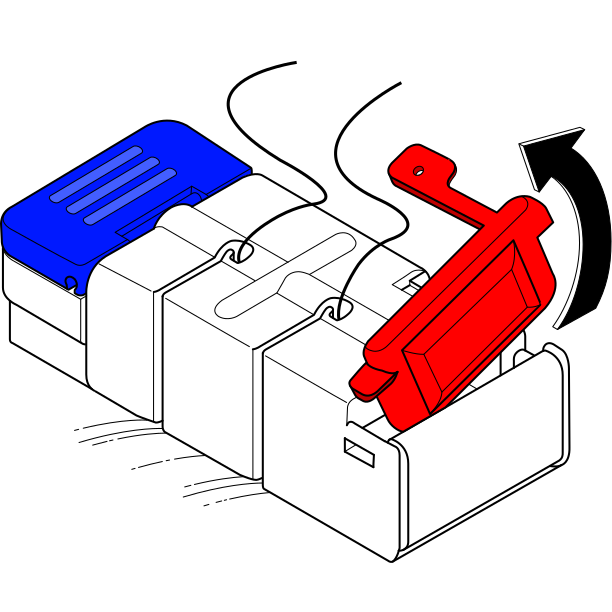
The first step is to rotate the red lever upward and away, which releases the pressure. Watch the video for the whole sequence — it is shorter than reading it, and you can play it again with the device in front of you.
Email me this video link
Once it is off
- Look at the site. A small amount of oozing as the device comes off is not unusual.
- If it bleeds, press firmly on the site with gauze and keep pressing for a full 10 minutes without lifting to check. Stay lying down.
- Once it has settled, keep the site clean and dry and take it easy for the rest of the day. No heavy lifting and no straining.
If bleeding does not stop
Keep pressing and stay lying down — do not get up to find a phone or to look for help. Have whoever is with you call us. If you are alone and the bleeding is heavy or will not slow with firm pressure, call 911 while continuing to press. Do not drive yourself anywhere.
Looking for how to prepare rather than what happens afterwards? Find your procedure instructions →