Skip to content
Outpatient coronary, structural, and rhythm procedures in Phoenix.Preparing for your procedure

Technology

Pulsed field ablation

The most significant change in catheter ablation in a generation. It replaced heat with electricity, it displaced radiofrequency as the default in about two years, and Heart Health Center was running it before most hospitals were.

The Change

From burning tissue to switching it off

For twenty years, catheter ablation meant temperature. Radiofrequency ablation heats tissue until it scars; cryoablation freezes it. Both work, and both have the same structural problem: heat and cold do not know what they are touching. The esophagus sits directly behind the left atrium. The phrenic nerve runs beside the right pulmonary veins. Thermal energy aimed at atrial muscle can reach all of it.

Pulsed field ablation works differently. Instead of temperature it uses very short, very high-voltage electrical pulses to open pores in the cell membranes of the tissue it targets — a process called irreversible electroporation. The cell cannot recover, and it stops conducting. No heating is involved.

What makes that matter clinically is the threshold. Heart muscle responds to the electrical field at a lower threshold than the esophagus, the phrenic nerve, or the walls of the pulmonary veins, so at the right field strength the lesion stays closer to the tissue it was aimed at.

That selectivity is worth stating precisely, because it is often overstated. It depends on the energy settings rather than being an inherent property of the technique — at high enough voltage or pulse duration, thermal effects return — and it is not complete: phrenic nerve injury has been reported. What the large post-approval registries actually support is that pulsed field ablation has a different safety profile from thermal ablation, not a uniformly better one. It trades a set of complications for a different and, in the atrium, generally smaller set.

Our Position

Early, not eventually

Adopting a new energy source is not a purchasing decision. It means rewriting protocol, retraining staff, and accepting a learning curve on a technology whose failure modes are different from the one you know. Heart Health Center did that while pulsed field ablation was still a minority of the market.

  • 01

    Among the first ambulatory surgery centers in the country to adopt pulsed field ablation.

  • 02

    First ASC to perform atrial fibrillation ablation with Biosense Webster's VARIPULSE platform.

    See the announcement →
  • 03

    Among the first centers to perform ablation with Boston Scientific's FARAWAVE pulsed field catheter.

  • 04

    The first standalone, freestanding ambulatory surgery center in the lower 48 states to perform atrial fibrillation ablation on Medtronic's Affera Mapping and Ablation System.

    See the announcement →

Platforms

The pulsed field systems in use here

Three pulsed field platforms, kept because they do different things well. A center running only one is choosing its tool before it sees the atrium. Which one a given case gets is the physician’s call at the table. Radiofrequency, covered below, is a fourth option.

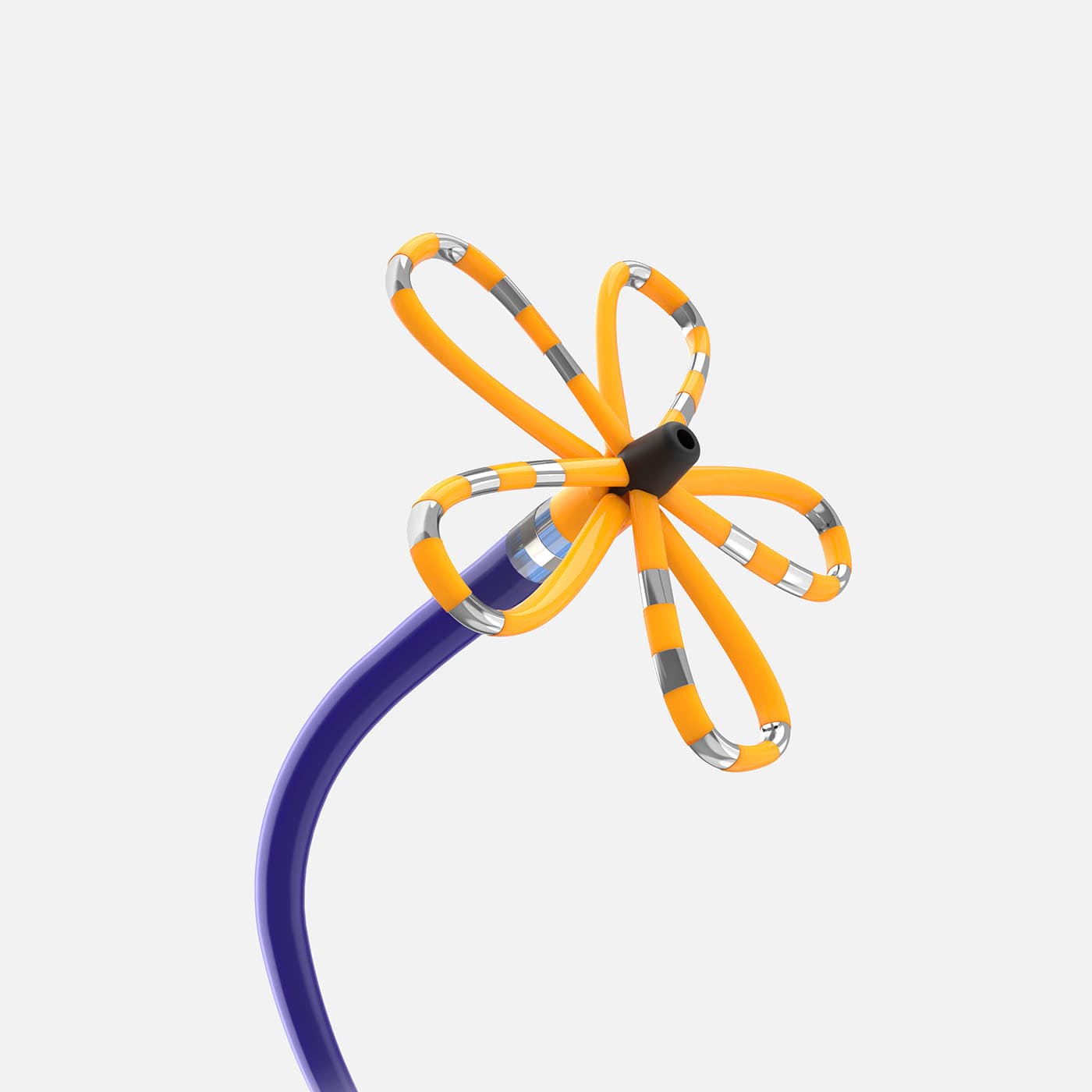
The FARAWAVE pulsed field ablation catheter with its five splines deployed in the flower configuration.
Image: Boston Scientific

Boston Scientific

FARAPULSE PFA System

FARAWAVE PFA catheter

The pentaspline pulsed field catheter that brought PFA into mainstream practice, and the platform behind the largest real-world safety registry to date.

FARAWAVE is a 12.8 F over-the-wire catheter with five splines that deploy progressively — from a basket shape to a five-petal flower — so the operator can match the geometry of each pulmonary vein rather than force one shape onto every anatomy. The generator delivers ultra-rapid high-voltage pulses that electroporate cardiac tissue without heating it.

What it changes

  • Shape adapts to the individual vein rather than the reverse
  • Non-thermal energy, delivered over-the-wire
  • Backed by the ADVENT randomised trial and the MANIFEST-17K registry

FDA status

FDA approved January 2024 for drug-refractory paroxysmal atrial fibrillation; labeling expanded to persistent atrial fibrillation in July 2025.

Pivotal trial

ADVENT — the first randomised trial comparing PFA head-to-head against standard-of-care thermal ablation (radiofrequency and cryoballoon) in paroxysmal AF. It met its safety and efficacy endpoints.
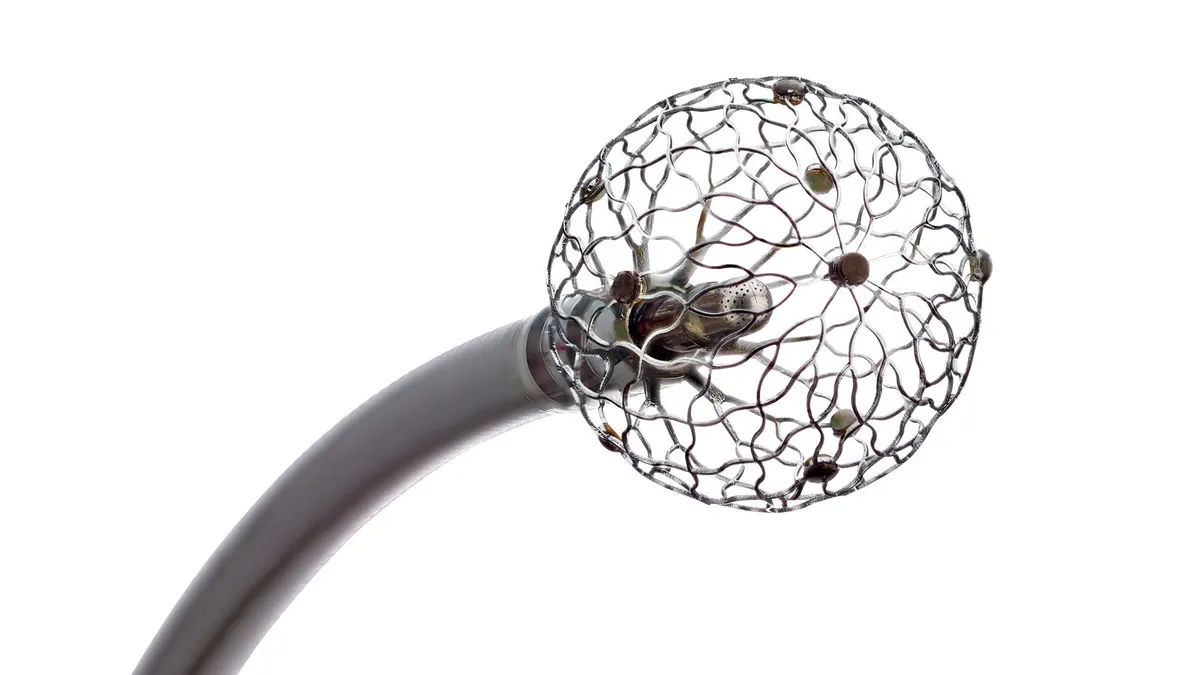
The Affera Sphere-9 catheter, showing its 9 mm nitinol lattice tip.
Image: Medtronic

Medtronic

Affera Mapping and Ablation System

Sphere-9 catheter

An all-in-one platform: high-density mapping and both pulsed field and radiofrequency ablation delivered through a single catheter.

The Sphere-9 uses a 9 mm nitinol lattice tip as a single spherical electrode. The same catheter builds the high-density electroanatomical map and then ablates — and because it runs off a dual generator, the operator can toggle between pulsed field and radiofrequency energy without exchanging catheters, swapping cables, or rebuilding the map. Pulsed field for the atrium; radiofrequency where a focal thermal lesion is the better tool.

What it changes

  • Mapping and ablation in one catheter — no exchange, one map
  • Toggles between pulsed field and radiofrequency energy mid-procedure
  • Wide-area focal design through an 8.5 F sheath

FDA status

FDA approved 24 October 2024 for persistent atrial fibrillation, and for radiofrequency ablation of cavotricuspid isthmus-dependent atrial flutter.

Pivotal trial

SPHERE Per-AF — an FDA IDE trial comparing the Sphere-9 catheter and Affera system against a conventional radiofrequency catheter and mapping system in persistent AF.

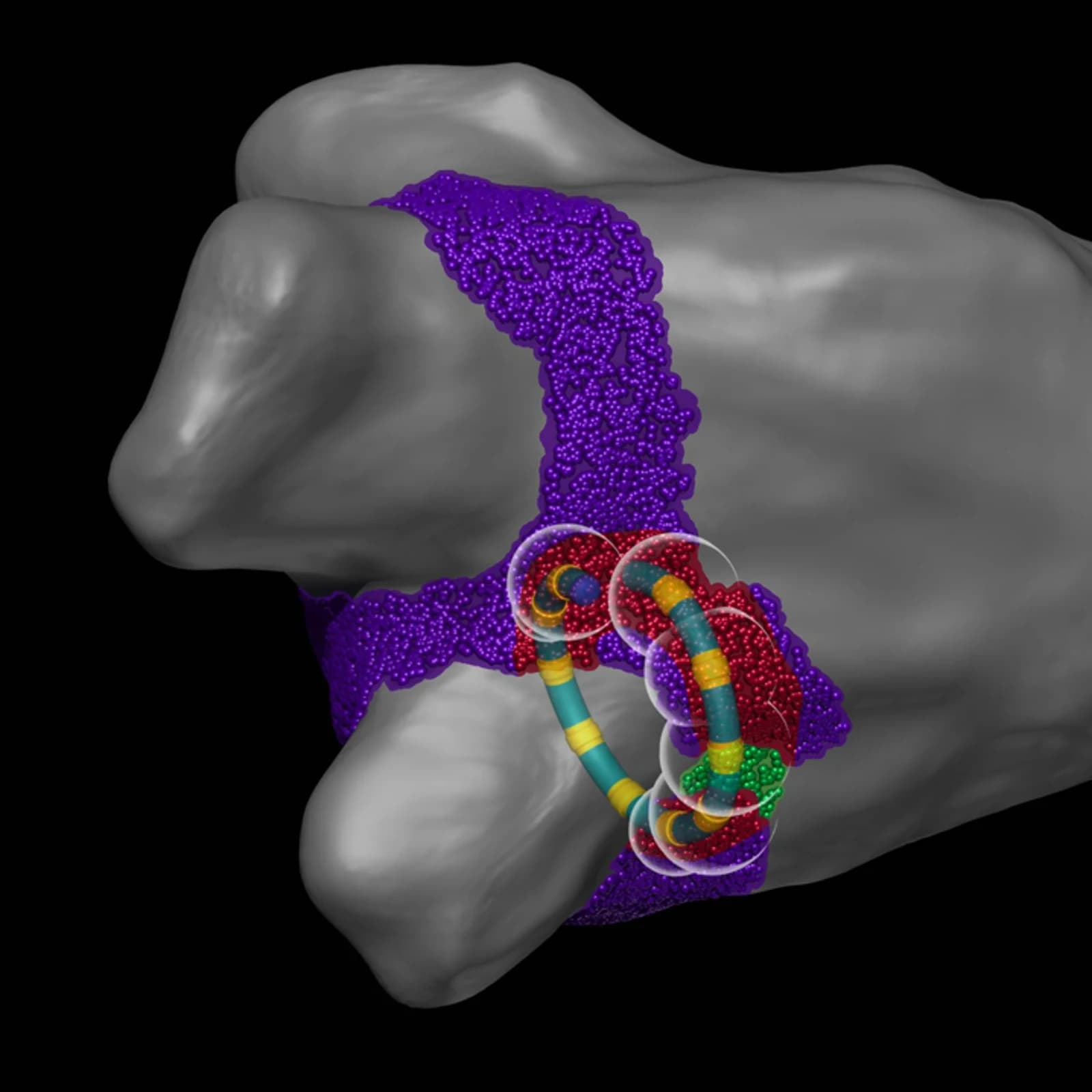
A simulation of the VARIPULSE variable-loop catheter positioned at a pulmonary vein inside the left atrium. The loop's electrodes are surrounded by translucent spheres representing the pulsed electric field, and the surrounding tissue is coloured to show the region the field reaches.
Image: Biosense Webster

Biosense Webster

VARIPULSE Platform

VARIPULSE variable-loop catheter

A variable-loop pulsed field catheter that runs on the CARTO 3 mapping system. Heart Health Center was the first ambulatory surgery center to perform atrial fibrillation ablation with it.

The catheter is a fully integrated variable-loop multi-electrode design: the loop diameter adjusts to the vein rather than the vein being approached with a fixed shape. It runs off the TRUPULSE generator and maps on CARTO 3, so the navigation and the map are the ones the operator already uses for radiofrequency work — one less thing to change when the energy changes.

What it changes

  • Loop diameter adjusts to the individual vein
  • Maps on CARTO 3, shared with the center's radiofrequency work
  • admIRE reported minimal-to-no fluoroscopy

FDA status

FDA approved 7 November 2024 for drug-refractory paroxysmal atrial fibrillation.

Pivotal trial

admIRE — a prospective multi-center US study of pulmonary vein isolation in symptomatic drug-refractory paroxysmal AF, reporting 85% peak primary effectiveness at twelve months with minimal-to-no fluoroscopy.

Radiofrequency

Where radiofrequency is still the better tool

Everything above is a case for pulsed field ablation, and it is a real one. It is not a case for abandoning radiofrequency. Pulsed field catheters are built around isolating the pulmonary veins, and a great deal of electrophysiology is not that. For those cases we use Biosense Webster’s radiofrequency platform and its CARTO 3 mapping system.

  • Arrhythmias that are not the pulmonary veins
  • When the circuit has to be found first
  • When lesion dose needs to be verifiable

For those cases we use Biosense Webster’s CARTO 3 system with a contact-force irrigated catheter. Which energy a given case gets is decided by the operator, on the anatomy and the arrhythmia in front of them — not by which machine the center happens to own.

Mapping

What the operator actually sees

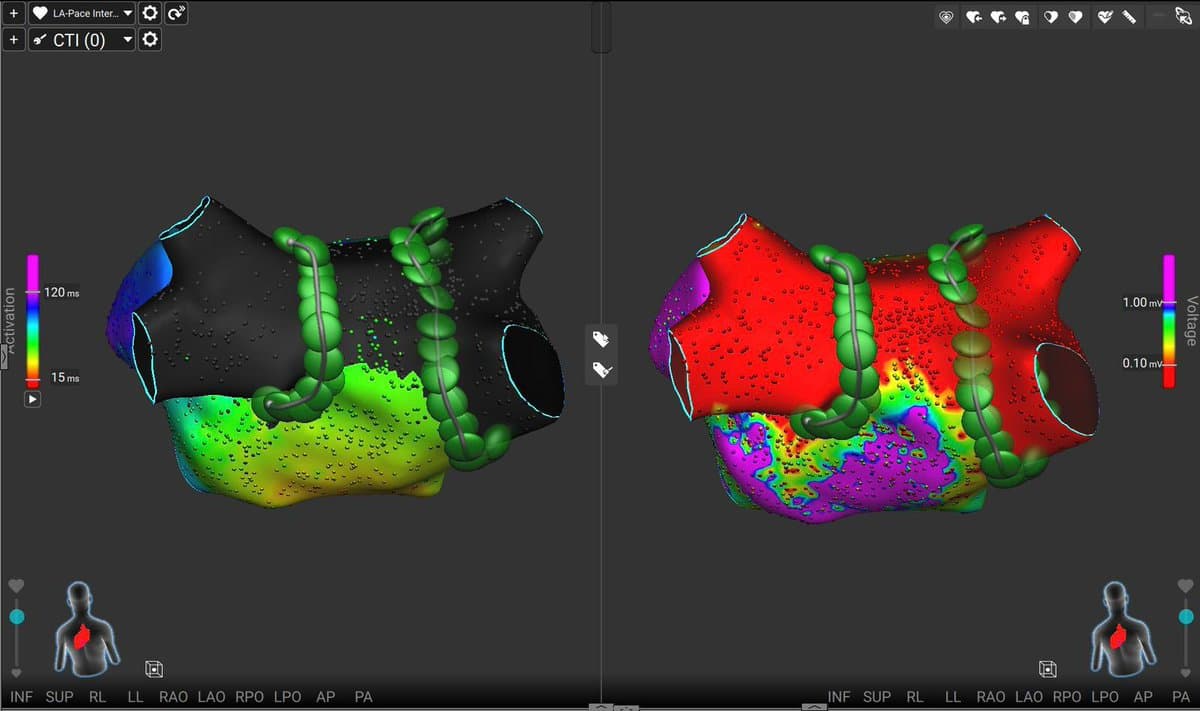
Ablation is not done blind. Before any energy is delivered, the catheter builds a three-dimensional electrical map of the atrium — and the same map is what confirms, at the end, that the pulmonary veins are genuinely isolated.

Two views of a left atrial electroanatomical map. The left panel shows an activation map; the right panel shows a voltage map. Both display chains of ablation lesions encircling the pulmonary veins.
Activation map (left) beside a voltage map (right) of the same left atrium, with the ablation lesion chains encircling the pulmonary veins. The colour scales show timing in milliseconds and signal amplitude in millivolts — how the operator confirms the veins are electrically isolated before finishing.Map courtesy of Vivek Y. Reddy, MD, published with permission.
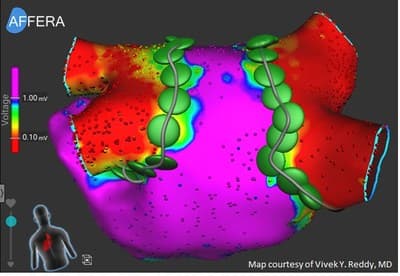
A voltage map of the left atrium showing low-amplitude scar in magenta where ablation lesions encircle the pulmonary veins.
The same principle in a single view: magenta marks tissue that no longer carries a signal, tracing the completed lesion set around the veins.Map courtesy of Vivek Y. Reddy, MD, published with permission.

What pulsed field ablation improved

  • It is more selective — though not absolutely so

    Radiofrequency and cryoablation work by temperature, and heat and cold do not distinguish between heart muscle and whatever sits behind it — the esophagus, the phrenic nerve, the pulmonary veins themselves. Pulsed field ablation is non-thermal, and cardiac muscle responds to the electrical field at a lower threshold than those neighbouring structures, so at appropriate settings the lesion stays closer to where it was aimed. That selectivity is a property of the settings rather than of the energy itself: push voltage or pulse duration far enough and thermal effects return. Nor is it complete — phrenic nerve injury has been reported with pulsed field ablation. The fair summary from large post-approval registries is that the safety profile differs from thermal ablation's rather than simply improving on it, which is why the risks below are their own list and not a shorter version of somebody else's.

  • The feared complications largely did not appear

    In MANIFEST-17K, a registry of 17,642 patients across 116 centers, there were no atrio-esophageal fistulas, no pulmonary vein stenosis, and no persistent phrenic nerve injury. The overall major adverse event rate was 0.63%.

  • It is faster in the atrium, at the cost of more X-ray

    In ADVENT, which compared the two head to head, pulsed field ablation ran shorter on every measure of time inside the heart: 106 minutes of total procedure time against 123, 59 minutes of left-atrial catheter dwell against 84, and 29 minutes of ablation against 50. Less time in the atrium and under anaesthesia is a real advantage. The trade-off is in the same paper and belongs next to it — fluoroscopy time was longer, 21 minutes against 14, meaning more X-ray exposure. That gap is thought to reflect how routinely radiofrequency is done with electroanatomical mapping that keeps the fluoroscopy down, and it is a gap that closes as mapping is used more with pulsed field too.

  • It suits same-day discharge

    Shorter procedures with fewer procedural adverse events make discharge on the day of the procedure more achievable — which is precisely what an ambulatory surgery center is built around.

And what it did not

Pulsed field ablation is not risk-free. It traded the thermal complications for a different set, and any center offering it should be able to name them.

  • Hemolysis and kidney injury

    Pulsed field energy can rupture red blood cells, releasing free hemoglobin. Clinically significant kidney injury from this is rare — in MANIFEST-17K, 0.03% of patients (5 of 17,642) required dialysis — and the risk relates to the number of lesions delivered, which is why lesion count, hydration, and post-procedure monitoring are managed deliberately.

  • Coronary spasm

    Pulsed field applications delivered near a coronary artery can provoke spasm. This was seen in 0.14% of patients (25 of 17,642) in MANIFEST-17K, and it is managed through where energy is delivered and through prophylaxis when ablating close to a coronary.

  • The risks every ablation carries

    Bleeding at the access site, fluid around the heart, and stroke remain possible with any catheter ablation regardless of energy source, and anticoagulation management still matters as much as it ever did.

Your physician will go through the risks that apply to you specifically, given your anatomy and history, before you consent.

Questions about your procedure?

Our team will confirm your date, walk you through preparation, and answer questions about insurance, sedation, and recovery.

Ask HHC