
Signature Program
Atrial fibrillation ablation
A catheter procedure that isolates the tissue triggering atrial fibrillation so a normal rhythm can hold. Between 2017 and 2023 this became one of the highest-volume outpatient AF ablation programs in the United States — and it moved to pulsed field ablation while most centers were still burning tissue.
- One of the first dedicated heart rhythm ambulatory surgery centers in the United States, founded 2017.
- One of the highest-volume outpatient atrial fibrillation ablation programs in the United States, 2017–2023.
- Published its outpatient electrophysiology experience in Heart Rhythm, including cases performed during the pandemic under the CMS Hospitals Without Walls initiative.
The Condition
What atrial fibrillation is
In a normal heartbeat, one electrical signal starts in the upper chambers and spreads in an orderly wave. In atrial fibrillation, the upper chambers are bombarded with rapid, disorganized signals instead. They quiver rather than contract, the pulse becomes irregular, and blood moves less efficiently — which is why AF causes palpitations, breathlessness, and fatigue, and why it raises the risk of stroke.
In most people, those disorganized signals originate in the pulmonary veins, where they enter the left atrium.
What ablation does about it
Ablation treats the problem at its source. Catheters are guided into the left atrium and used to create a deliberate ring of non-conducting tissue encircling the pulmonary veins. Once the ring is complete, the abnormal signals remain trapped inside the veins and can no longer reach the rest of the atrium. This is called pulmonary vein isolation, and it is the foundation of every AF ablation.
Some patients need additional lines or targets beyond the pulmonary veins, depending on how long they have had AF and what the mapping shows on the day.
What has changed — recently and completely — is how that ring is made.
How We Do It
We use pulsed field ablation
For two decades, ablation meant temperature — radiofrequency energy heating tissue until it scarred, or a cryoballoon freezing it. Pulsed field ablation replaced the heat with very short, high-voltage electrical pulses that open pores in the cell membrane until the cell can no longer recover — irreversible electroporation — rather than relying on heating or freezing.
The reason this matters is what sits behind the left atrium. The esophagus is millimetres away. The phrenic nerve, which drives the diaphragm, runs beside the right pulmonary veins. Heat and cold cannot tell those structures apart from heart muscle.
Pulsed field energy distinguishes between them more than heat does, though not perfectly. Cardiac muscle responds to the electrical field at a lower threshold than the surrounding tissue, so at appropriate settings the lesion stays closer to where it was aimed. In a registry of 17,642 patients across 116 centers, there were no atrio-esophageal fistulas, no pulmonary vein stenosis, and no persistent phrenic nerve injury — which is a strong result, not a guarantee, and the selectivity behind it depends on the energy settings used.
It is also quicker inside the heart. In ADVENT, the trial that compared the two directly, pulsed field ablation ran about seventeen minutes shorter overall and around twenty-five minutes shorter in the left atrium itself. Less time under sedation and less time with a catheter in the atrium is a large part of what makes same-day discharge appropriate in the first place. How much time any individual procedure saves depends on the platform, the mapping strategy, and whether it is a first ablation or a repeat.
Pulsed field ablation carries its own risks rather than none, including hemolysis and coronary spasm. Both are uncommon and both are described honestly on the technology page.
Our position
- Among the first ambulatory surgery centers in the country to adopt pulsed field ablation.
- First ASC to perform atrial fibrillation ablation with Biosense Webster's VARIPULSE platform.See the announcement →
- Among the first centers to perform ablation with Boston Scientific's FARAWAVE pulsed field catheter.
- The first standalone, freestanding ambulatory surgery center in the lower 48 states to perform atrial fibrillation ablation on Medtronic's Affera Mapping and Ablation System.See the announcement →
Three platforms are in service here: Boston Scientific FARAPULSE PFA System, Medtronic Affera Mapping and Ablation System, and Biosense Webster VARIPULSE Platform.
The Procedure
How the day goes
Plan for most of the day at the center, even though the ablation itself occupies only part of it. Bring someone who can drive you home and stay with you overnight.
- 1
Arrival and preparation
You check in, change, and meet the nurse who will stay with you through the visit. An IV is placed, monitoring goes on, and your physician reviews the plan with you and answers questions before anything begins.
- 2
Imaging
Where it is indicated, a transesophageal echocardiogram is performed first to confirm there is no clot in the left atrial appendage. This is done under sedation and adds a short amount of time to the visit.
- 3
Sedation
Ablation is performed under sedation managed by the anesthesia team. You will not be aware of the procedure. The depth of sedation is chosen for your airway, your history, and the type of ablation planned.
- 4
Access and mapping
Catheters are advanced through a vein in the groin to the heart. A three-dimensional map of the left atrium is built, showing the pulmonary veins and the electrical signals coming from them.
- 5
Ablation
Energy is applied in a ring around each pair of pulmonary veins, creating a line of tissue that no longer conducts. The team then confirms that each vein is electrically isolated before finishing.
- 6
Recovery and discharge
The catheters come out, the access site is closed, and you rest flat for a defined observation period while the site seals and your rhythm is monitored. When you meet the discharge criteria, you go home the same day with written instructions and a follow-up plan.
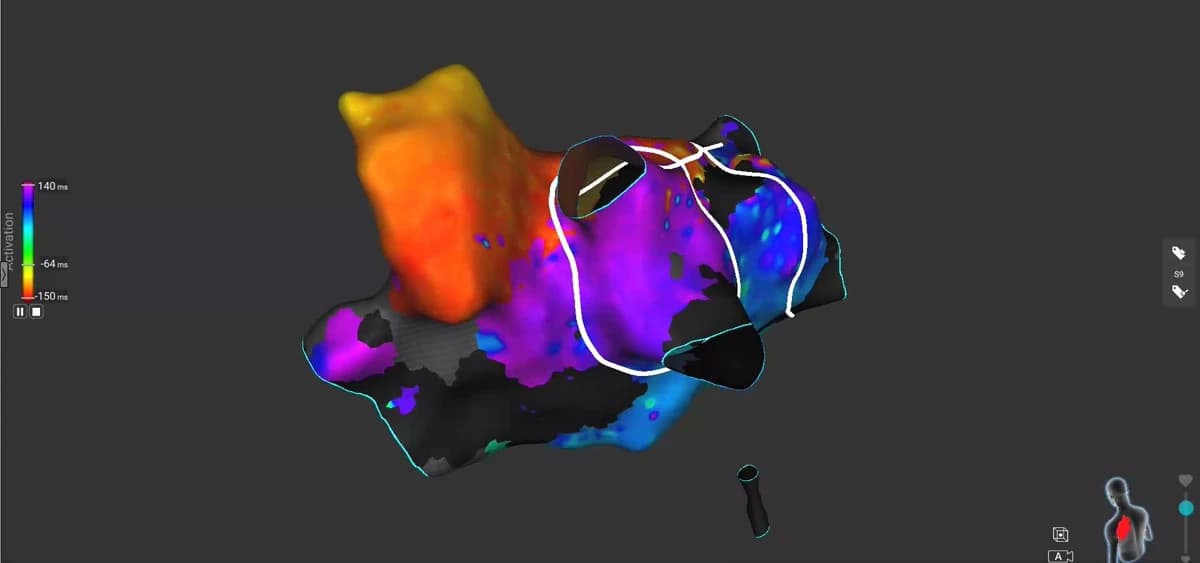
A left atrium at the end of an ablation here. The colours show activation timing across the chamber; the white lines are the completed lesion sets encircling each pair of pulmonary veins. Closing those rings is what electrically disconnects the veins from the atrium.
Affera · Medtronic. From a case performed at Heart Health Center.
Expectations
Being straight with you about results
Ablation is a treatment, not a guarantee. Some patients need a second procedure to complete or reinforce the isolation lines. It is normal to have occasional irregular beats during the first weeks while the tissue heals, and your medications — particularly anticoagulation — are managed on a schedule that continues past the procedure itself.
Like any cardiac procedure, ablation carries risk: bleeding at the access site, fluid around the heart, and stroke among them. Those risks are uncommon, and reducing them is the whole purpose of careful patient selection, imaging, written protocol, and the on-site capability described on the safety and quality page. Your physician will go through them with you specifically, in the context of your own history, before you consent.
Our Experience
Our procedural experience
Center-reported totals as of August 30, 2026. These figures describe procedure volume, not treatment success rates.
- 1,800
- Ablation procedures performed
- Performed at Heart Health Center, as reported August 30, 2026.
- 1,400
- Heart rhythm device implants
- Pacemakers, defibrillators, and other cardiac rhythm management devices.
- 1,200
- Heart catheterization procedures
- Diagnostic and interventional catheterization procedures.
Questions about your procedure?
Our team will confirm your date, walk you through preparation, and answer questions about insurance, sedation, and recovery.